
I stand in the quiet halls of the Collegio San Giuseppe in Turin, facing a case that holds a legion of hummingbirds. Over two hundred, forever still, their wings aglow with emerald and ruby, caught in a flight that no longer exists. I, Leonardo Caffo, pause to gaze at them, a weight settling in my chest. These tiny creatures, once defying gravity with their frenetic hum, are now prisoners of glass. Why do we stop them from flying?
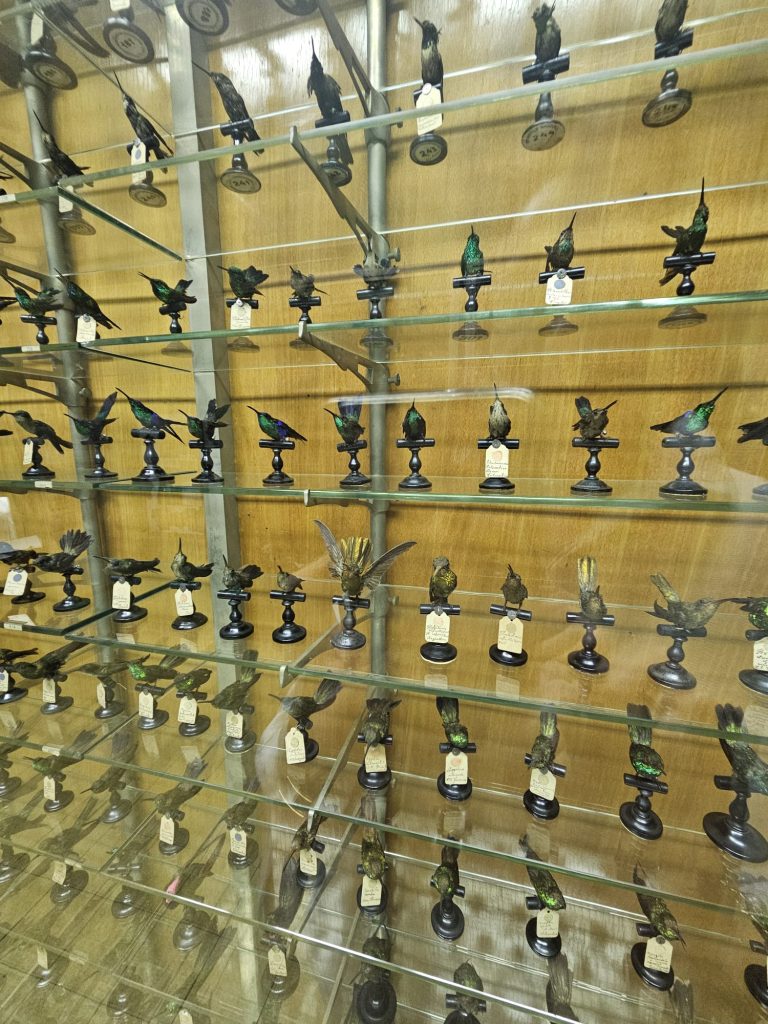
Collecting is an ancient urge, one that makes us human and betrays us in the same breath. To gather a hummingbird, to pin it in a pose that mimics life, is to claim it. We name them—Trochilus polytmus, Amazilia tzacatl—and in naming, we dominate. To name is to draw a line, to say: you are mine, I know you, I control you. But a hummingbird is not a name. It is a pulse, a flash of color darting through flowers, a breath of life that does not belong to us. Yet here they are, in this hall of the Collegio, founded in 1875, transformed into trophies of an era that sought to cage the world.
Turin, with its streets whispering secrets, feels like the perfect stage for this encounter. These hummingbirds, torn from distant forests, rest in an institution that shapes minds. But what do we truly learn from these motionless bodies? That beauty can be captured, but at a cost. Each case is a confession: we have grounded their flight to marvel at them. We have silenced their hum to make them a painting, a dead poem. And I, who spend my life seeking a dialogue with the non-human, feel complicit in this theft.
I look into their eyes, tiny black pearls, and imagine the skies they will never see again. I think of the forests they will not cross, the flowers they will not kiss. Collecting may be an act of love, but it is a selfish love, one that smothers what it adores. Naming is domination, each name a chain. What if we stopped? What if we left the hummingbirds nameless, free from cases, free from our need to possess? Perhaps then we would learn to truly see them: not as objects, but as fragments of a world that breathes with us.
These hummingbirds, suspended in their eternal non-flight, are a mirror. They show me a humanity that seeks to control, that fears what slips away. But they are also an invitation. To let go, to cease naming, to restore flight to those born to dance in the air. Here, in the Collegio San Giuseppe, under Turin’s dusty light, I make a promise to myself: to look without possessing, to love without imprisoning.
